
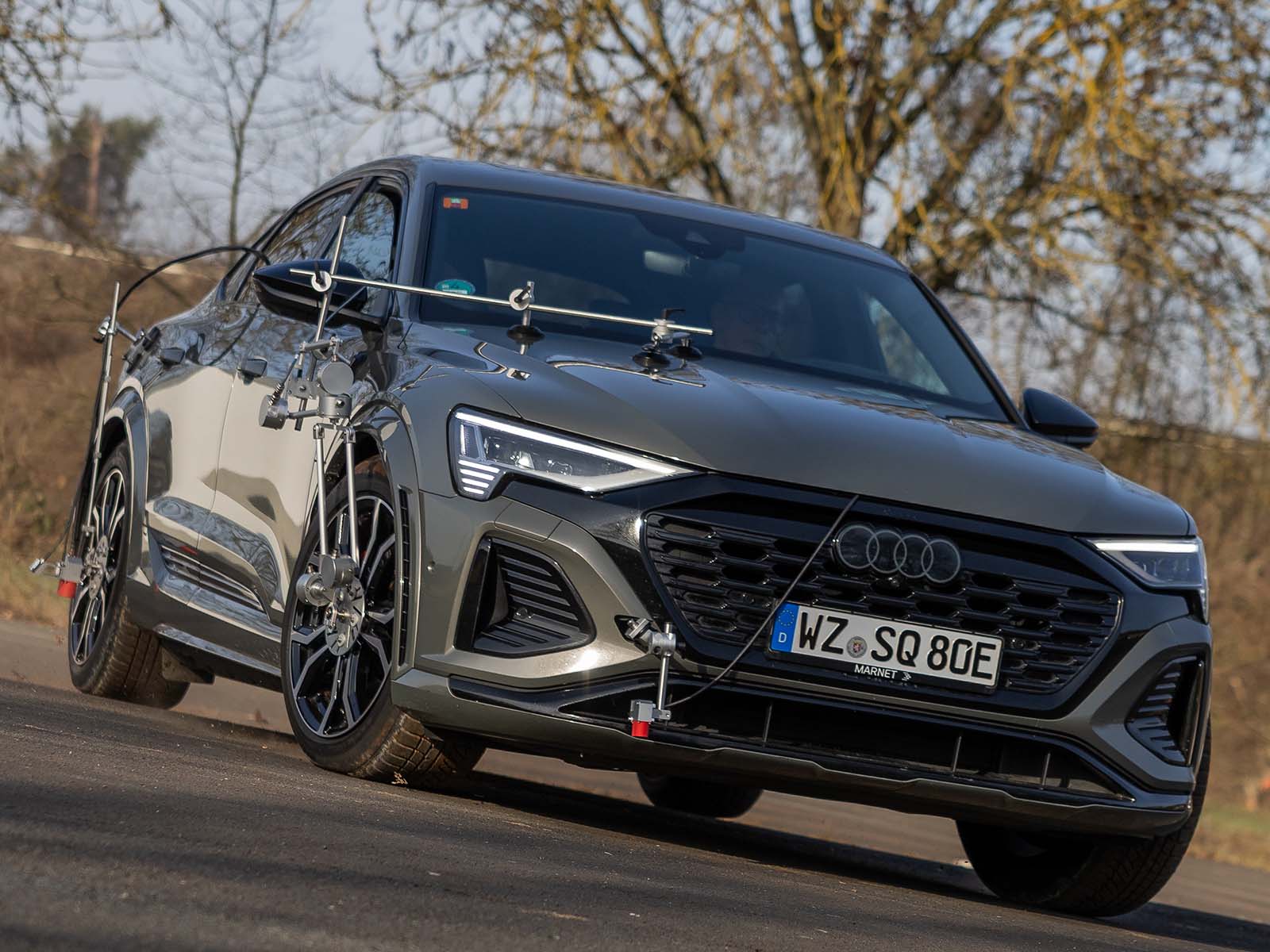
How do you capture vehicle dynamics as a complete system — not just isolated parameters — under real driving conditions? That’s exactly what a joint project with the Formula Student team at Esslingen University of Applied Sciences set out to answer.
The goal: measure all relevant vehicle dynamics parameters holistically, in sync, and dynamically on the track. Traditional methods often rely on test rigs like K&C or damper dynos. This approach captures real vehicle behavior in its full complexity.
At the core is the combination of several complementary sensor systems:
The optical ground speed sensor OMS delivers high-precision vehicle velocity in both longitudinal and lateral directions. Depending on the mounting location, it provides either the vehicle sideslip angle (mounted at the center of gravity) or the tire slip angle (mounted at the axle) — both critical for characterizing vehicle dynamics.
The height measurement system HMS adds another layer. Using three laser distance sensors, it captures pitch and roll motion at high resolution. Alternatively, two sensors per wheel can determine dynamic camber relative to the road surface — a key factor in tire contact and the resulting forces.
The third core element is the wheel vector sensor (WVS). It measures wheel motion relative to the chassis in all three spatial directions, plus steer and camber angle. This makes actual wheel guidance under dynamic conditions visible — including all elasto-kinematic effects that occur during real driving.
Wheel Force Transducers (WFT) round out the setup. They directly measure forces and moments acting on the wheel in all six degrees of freedom. This fully quantifies the tire-vehicle interface: longitudinal, lateral, and vertical forces along with the corresponding moments — all captured at high dynamics under real driving conditions. Combined with the slip angles from the OMS and the kinematic data from WVS and HMS, a consistent picture of tire force generation emerges. This enables a much deeper understanding of tire behavior and provides a solid basis for validating tire models and full-vehicle simulations.
Only by combining these systems does the full picture come together: from tire interaction to vehicle motion to the resulting elasto-kinematics.
A key focus of the project is demonstrating solutions for different use cases and budgets — from cost-effective setups for Formula Student teams to high-precision measurement chains at OEM or motorsport level.
Beyond the sensors themselves, the project also addresses practical implementation: vehicle integration, calibration strategies for repeatable data, and consistent correlation of different measurement quantities.
The real value lies in how the data is used. The measurements enable direct vehicle optimization — better understanding of tire behavior, suspension tuning, or control strategies. At the same time, they serve as high-quality reference data for simulation validation, shortening development cycles and enabling more informed decisions.
The project marks a clear step forward: away from isolated test rig measurements, toward an integrated, data-driven analysis of vehicle dynamics under real driving conditions.
Benni Stauder will present this topic at the Automotive Testing Expo 2026 in Stuttgart: “From High-Precision Measurements to Faster Lap Times — Holistic Vehicle Dynamics Analysis in the Vehicle.” Program details to follow.