
WVS – Wheel Vector System
Full Dynamic Wheel Kinematics in Real Time
The WVS (Wheel Vector System) by Sensoric Solutions measures wheel position in X, Y and Z, captures camber angle, steering angle and toe, and delivers a complete picture of wheel kinematics — in real time, under real driving conditions.
Combined with the optical-inertial OMS sensors and the laser-based HMS system, the WVS forms a fully synchronized measurement system for complete vehicle and axle dynamics. All sensors are configured through a shared web interface — directly in the browser, no installation required. Data output is via CAN/CAN-FD and Ethernet with PTP synchronization.
All Parameters of the Wheel Vector System
Wheel Position X/Y/Z
Toe
Camber Angle
Wheel Speed
Steering Angle
and many more with OMS & HMS
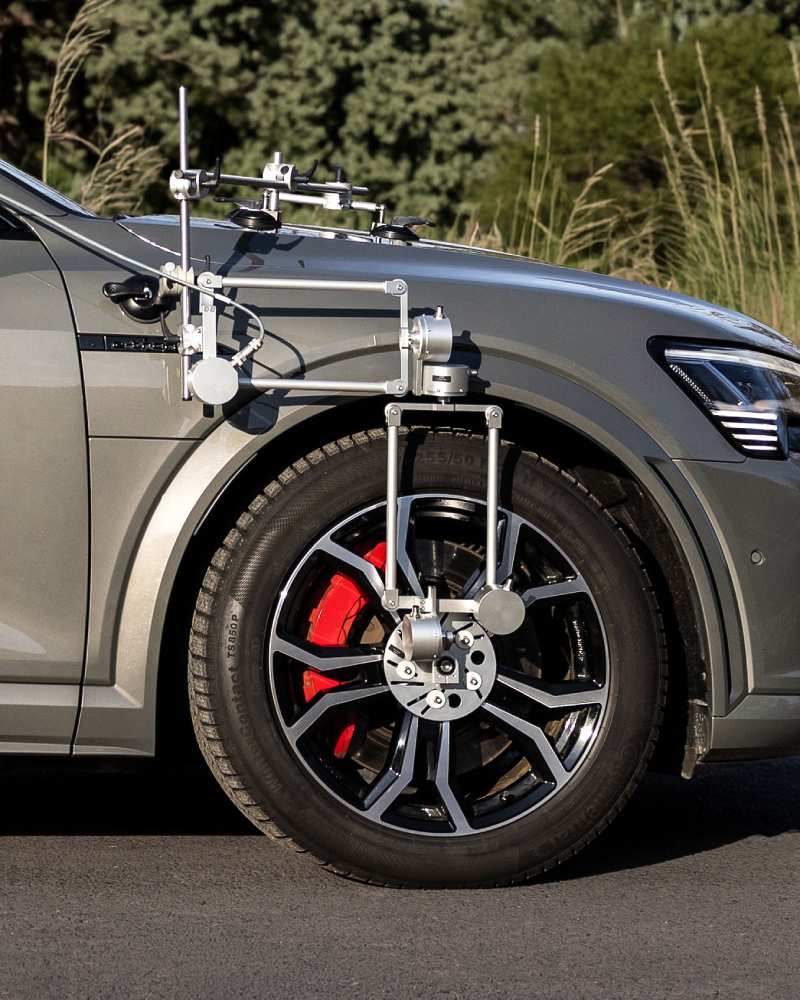
Key Benefits
- Complete wheel kinematics: Wheel position in X, Y and Z plus camber, steering angle and toe — all in one system
- Parallelogram mechanism: Maintains constant horizontal sensor alignment regardless of steering input or driving condition
- Up to 4 wheels simultaneously: One integrator box captures all wheels in sync
- Modular and expandable: Compatible with OMS 7, OMS Race and HMS 1 for a complete vehicle dynamics measurement system
- Quick installation: Suction cup mounts on the body, bearing-mounted hub adapter on the wheel via studs or clamps
- Flexible data integration: CAN/CAN-FD/Ethernet output with standardized DBC file for existing DAQ systems
- Browser-based configuration: Shared web interface for all sensor systems — no software installation, no additional license
Applications
- Wheel kinematics analysis
- Suspension validation
- Dynamic compliance measurement
- Tire development
- Simulation & hardware-in-the-loop (HIL)
- Ride comfort analysis (in combination with OMS and WFT)
- Motorsport: toe and camber compliance, static setup vs. on-track geometry
System Architecture
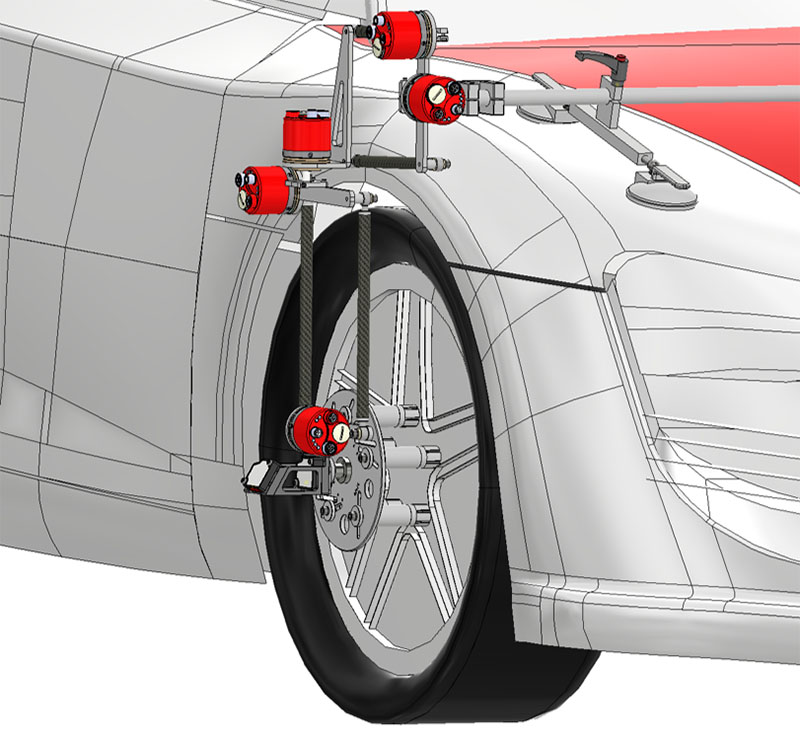
The WVS captures wheel motion relative to the vehicle body using five optical encoders and one incremental encoder. A parallelogram mechanism maintains constant horizontal sensor alignment in all driving situations — independent of steering motion. This also prevents steering input from affecting any additional wheel-mounted sensors such as camber measurement systems or wheel speed encoders.
The system automatically compensates for wheel runout, radial runout and mounting errors — delivering high measurement accuracy from the very first wheel revolution.
All encoder signals are fused in the integrator box and output as fully computed measurement channels via CAN/CAN-FD or Ethernet.
Vehicle Installation
The WVS is designed for fast setup and teardown in test operations:
Body side: Suction cup mounts secure the sensor bracket to the vehicle body. Fully rubberized pads protect the paint finish.
Wheel side: A bearing-mounted hub adapter attaches to the wheel via lug bolts using studs or clamps. The adapter accommodates various bolt patterns and lug nut configurations.
Custom solutions: Specialized wheel adapters are available for unique requirements — such as truck wheels with stud-piloted hubs.

Integrator Box
The integrator box is the central processing unit of the WVS system. It receives signals from up to four WVS units. All data is output fully synchronized via CAN/CAN-FD or Ethernet.
Features:
- Dual CAN-FD channels for flexible data output
- Configuration via shared web interface — directly in the browser, no installation required
- Time-synchronized data output (PTP)
- Standardized DBC file for easy DAQ integration
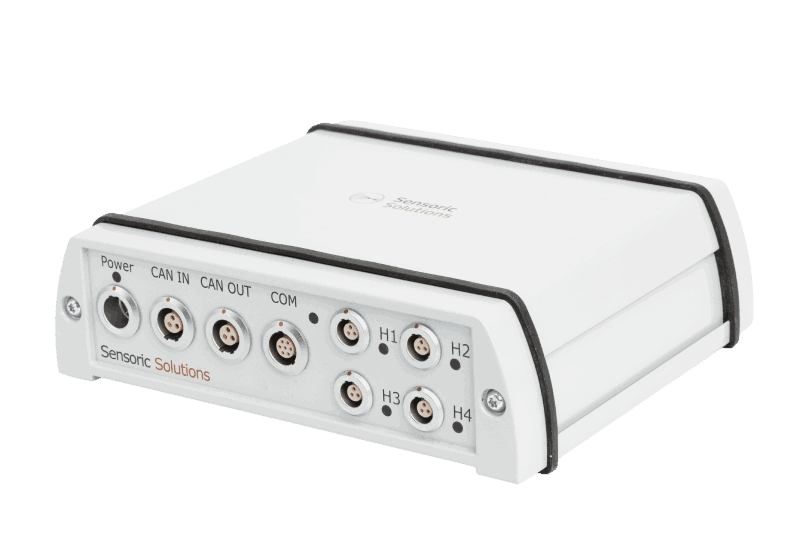
Connections and Interfaces
- 4 × WVS inputs
- 1 × Power
- 1 × Ethernet (configuration, live data)
- 2 × CAN-FD (data output)
Part of a Modular System
The WVS works as a standalone system but reaches its full potential when combined with the other Sensoric Solutions sensor systems:
| System | Measured Parameters |
|---|---|
| OMS 7 / OMS Race | Speed, vehicle sideslip angle, tire slip angle, acceleration, pitch/roll |
| HMS | Ride height, camber, pitch/roll relative to road surface, torsion |
| WVS | Wheel position X/Y/Z, camber, steering angle, toe, wheel speed |
All systems are configured through a shared web interface — directly in the browser, no installation required. Data output is via CAN/CAN-FD and Ethernet with PTP synchronization. The result: a complete vehicle dynamics measurement solution from a single vendor.

Why WVS from Sensoric Solutions?
Measuring wheel kinematics has traditionally meant combining multiple systems from different vendors — and dealing with the overhead of synchronizing and merging their data after the fact. The WVS delivers all relevant wheel kinematics parameters in one compact, rugged package and integrates seamlessly with the existing Sensoric Solutions sensor portfolio. The result: one synchronized measurement system for complete vehicle dynamics — modular, expandable and ready to plug into your existing data pipeline.
Ready to See It in Action?
Service-Hotline:
+49 641 972499-77
Have questions about the WVS or want to discuss your specific test setup? Our engineering team can help you select the right configuration and support integration into your data acquisition environment.